✓ Instant Digital Access After Payment | ✓ Premium Parenting Resource | ✓ Scripts, Tools & Trackers Included | ✓ One-Time Payment · ₦8,499
Nuvera Health & Wellness Presents
Your Child Is Not Difficult. Their Brain Is Hooked.
The daily battles, the meltdowns, the sneaky screen time at midnight — none of it means you have failed as a parent. It means your child’s brain is caught in a loop that was designed by the world’s smartest engineers to be almost impossible to break without a system.
Unplug My Child is the 30-day parent reset system that gives you that system — practical, structured, and grounded in how the developing brain actually works.

- Stop the daily phone battles without shouting or confiscating
- Understand why your child's brain is so attached to the screen
- Build routines and boundaries that your child actually respects
- Restore focus, calm, and real connection at home
- Scripts, trackers, and tools included — no guesswork
Investment ₦8,499 One-time payment
📩 Instant digital delivery through Selar or Nestuge · No physical shipping · Access via email after payment
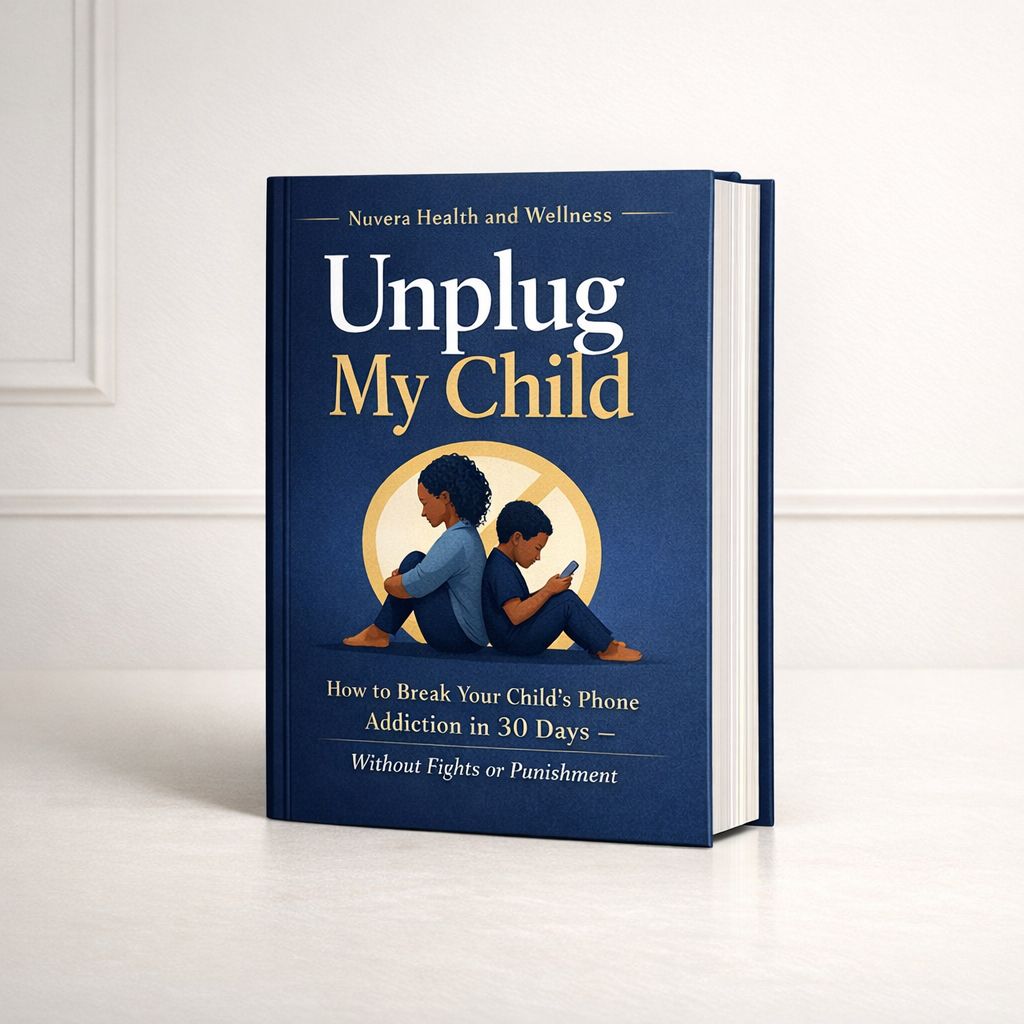
- 30-Day Implementation Guide
- Parent Conversation Scripts
- Worksheets & Weekly Trackers
- Family Technology Contract
- Made for Nigerian Families
Does Any of This Feel Like Your Home?
You are doing your best. But something has shifted in your home — and you can feel it every single day.
🍽️
The Dinner Table Meltdown
You ask them to drop the phone. Five minutes later you are repeating yourself. By the time food hits the table, you are already tired and the evening is tense before it even starts.
🌙
Midnight Scrolling You Cannot See
They say goodnight and go to their room. But you know — or suspect — the screen comes back on the moment the door closes. And in the morning, they are impossible to wake up.
📚
The Homework Standoff
Books are open on the table, but their mind is somewhere else entirely. Getting them to study without the phone nearby has become a 45-minute war every single weekday.
😶
Emotional Withdrawal
They are in the same room as you but a million miles away. When you take the phone, they go quiet, irritable, or shut down completely. You miss the child who used to talk to you.
🎮
The Gaming Obsession
One more game turns into three hours. When you interrupt, it is as if you have committed an act of violence. Tantrums, shouting, door slamming — over a screen.
🔁
The Endless Negotiation
You set a limit. They push. You give in a little. They push further. Tomorrow the whole cycle repeats. You are exhausted — and you feel like you are slowly losing authority in your own home.
Before We Go Further
You Are Not a Bad Parent. You Are a Modern Parent Facing a Modern Problem Without a Manual.
The phone probably entered your home with good reason. Maybe it helped with schoolwork. Maybe it bought you an hour of peace on a difficult day. Maybe it was a reward that seemed harmless at the time.
But somewhere between then and now, the balance shifted. What started as a tool became a need. And the more you tried to pull back, the harder the resistance grew — because the brain had been trained.
This is not a character flaw in your child. It is not failure on your part. It is a predictable outcome of powerful, commercially engineered technology meeting a young, still-developing brain — without structure to protect it.
Guilt will not change the pattern. Structure will.
Why the Screen Has Such a Powerful Grip on Your Child
This is not about willpower. The technology was engineered to create dependency — and a child’s brain is particularly vulnerable to how it works.
Dopamine Loops
Every notification, like, or in-game reward triggers a small dopamine hit. The brain learns to expect this reward and begins to crave the behaviour that produces it — over and over again.
Variable Reward
Unpredictable rewards — sometimes a great video, sometimes a dull one; sometimes a win, sometimes a loss — are more addictive than predictable ones. This is the same mechanism behind slot machines.
Social Validation Loops
Likes, comments, follower counts, and online status feed a deep developmental need for belonging and approval. The screen offers this instantly — at a level that real-world interactions often cannot match.
Incomplete Loops
Many apps are designed to always leave something unfinished — a conversation mid-reply, a video that autoplays, a level left incomplete. The brain feels compelled to return to close the loop.
Underdeveloped Self-Regulation
Children's prefrontal cortex — the part of the brain responsible for self-control, planning, and impulse management — is not fully developed. They genuinely cannot just stop without help building that capacity.
Why 'Just Stop' Does Not Work
When a screen fills a child's need for stimulation, reward, or connection, simply removing it leaves a gap the child does not know how to fill. Without a replacement, the urge to return to the phone is overwhelming.
Why Confiscating the Phone and Shouting Often Makes Things Worse
- Confiscating the phone without providing a replacement leaves a need unmet — and unmet needs intensify, they do not disappear.
- Shouting during a screen-time conflict often escalates the moment and damages the relationship you need intact for the work of change.
- Inconsistency — rules that shift based on your mood or their crying — teaches the child that limits are negotiable if they push hard enough.
- Making the phone forbidden without explanation often increases its psychological power — forbidden things become more desirable, not less.
- Punishment removes the visible symptom but leaves the underlying need, habit, and dependency completely untouched.
What changes behaviour is not pressure — it is structure, consistency, conversation, and gradual replacement. That is exactly what Unplug My Child gives you.
Introducing the Solution
What You Need Is Not Another Article. It Is a System.
There is no shortage of parenting advice on the internet. There are hot takes, threads, short reels, and opinion pieces — all circling the same problem without giving you anything to actually do on Monday morning.
What Nigerian parents dealing with this problem actually need is a structured, sequenced, day-by-day implementation plan — grounded in how the brain works, written for the realities of your home, and specific enough that you know exactly what to say and do at each stage of the process.
That is what Unplug My Child is built to be.
The Product
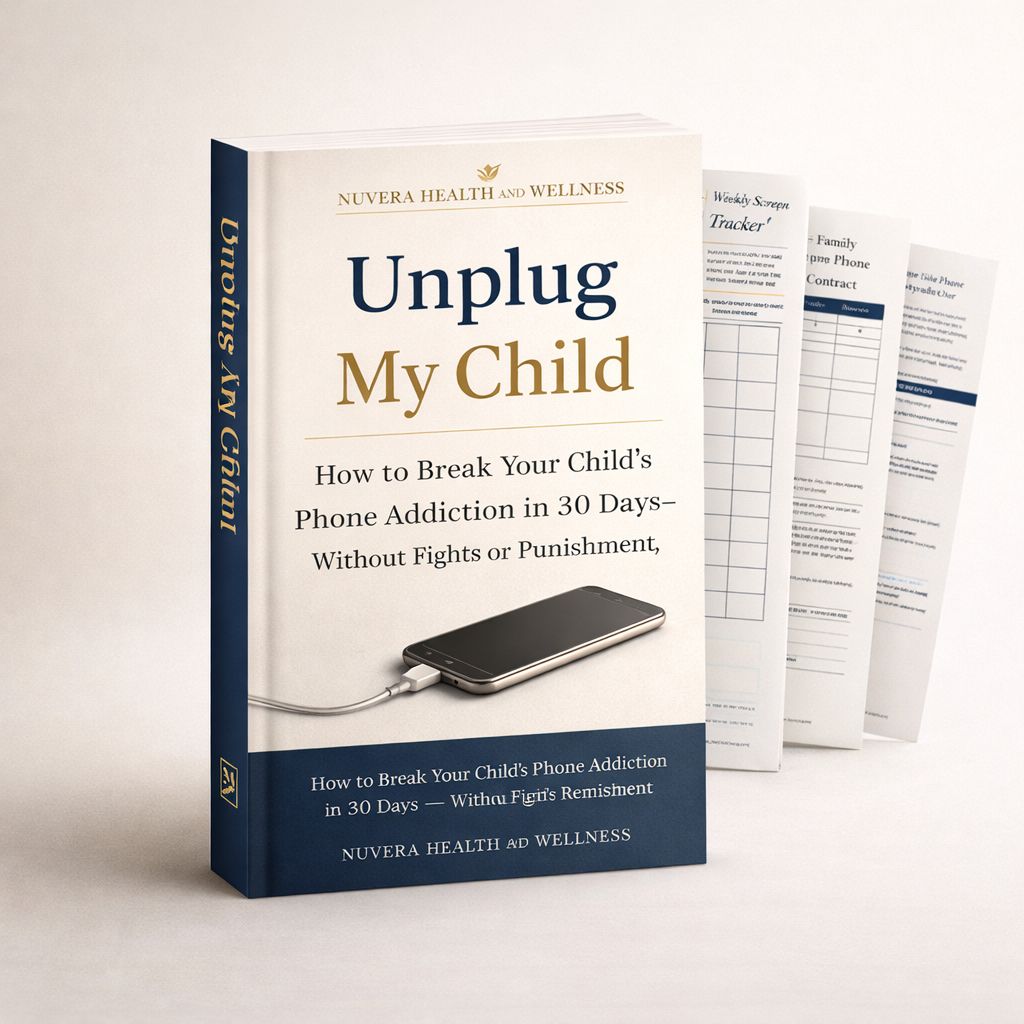
Unplug My Child
The 30-Day Parent Reset System for Raising a Focused, Present Child in a Screen-Saturated World
A premium digital parenting resource and implementation guide — designed for parents of children aged 5 to 17 who want to reduce unhealthy phone dependence without conflict, without guilt, and with a clear plan.
- 30-day step-by-step parent action plan
- Psychologically grounded — no fluff
- Scripts, trackers, tools, and contract templates
- Built for Nigerian family life
- Instant digital access after payment
Investment
₦8,499 One-time · No recurring fees
📩 Instant digital delivery via Selar Or Nestuge· One-time payment · No physical shipping
What Is Inside the Guide
This is not a theory book. Every chapter has a purpose and every tool has a clear job to do in your home.
- The Psychology Section — plain-language explanation of how screen dependency forms in children, so you can address the root rather than the surface behaviour.
- The 30-Day Step-by-Step Plan — daily and weekly guidance that builds from observation to structure to independence, without overwhelming your schedule.
- Parent Conversation Scripts — exact words for the conversations you have been avoiding or getting wrong: introducing limits, handling resistance, addressing sneaky behaviour.
- Worksheets and Tools — fillable tools for each phase of the plan, so you are working with a record of your child's progress, not just hoping you remember.
- Weekly Progress Trackers — simple forms that help you measure what is actually shifting week by week, so you can adjust the approach with clarity instead of frustration.
- Replacement Activity Strategies — a curated bank of offline alternatives that match the stimulation and engagement level your child currently gets from the screen.
- The Family Technology Contract — a ready-to-use agreement template that puts expectations in writing and creates a fair, shared framework your child is part of setting.
- Troubleshooting and Relapse Support — guidance for when progress stalls, when your child pushes back hard, or when old habits creep back in after initial improvement.
The Core System Inside the Guide
The CALM Framework
The four-part system at the heart of the Unplug My Child 30-day plan — built so that every action you take is purposeful and connected.
C
Conversations, Not Commands
Shift from issuing orders to opening dialogue. Children who feel heard are significantly more likely to cooperate. The guide provides scripts for doing this even when you are frustrated.
A
Alternatives That Compete
Replace, do not just remove. The guide equips you with engaging offline alternatives matched to your child’s screen type — so the phone is not the only compelling option in the room.
L
Limits With Logic
Set limits your child can understand and agree to. Arbitrary rules breed rebellion. Explained, fair, and co-created boundaries create a foundation of respect that holds even under pressure.
M
Monitor and Reward
Track progress without turning into a surveillance officer. Acknowledge and reward the improvements that appear — however small. Positive reinforcement builds compliance far more effectively than punishment.
Understanding Your Child's Screen Type
Not all screen dependence looks the same. The guide helps you identify which pattern your child fits — so you respond to the actual need, not just the surface behaviour.
Type 01
The Passive Scroller
What it looks like:
Hours lost to short video content — no particular goal, no engagement with others. Just endless scrolling that empties an afternoon without the child being able to say what they watched.
The underlying need:
Stimulation and emotional regulation — often boredom avoidance or stress relief without healthy coping tools yet in place.
What helps:
Structured boredom exposure, offline creative stimulation, and building comfort with quieter activities progressively.
Type 02
The Gaming-Focused Child
What it looks like:
Intense, focused gaming sessions that crowd out homework, family time, sleep, and social interaction. Withdrawal triggers aggression or emotional shutdown when the game is interrupted.
The underlying need:
Mastery, achievement, competition, and a clear feedback loop — needs that are deeply human but being met entirely inside a virtual environment.
What helps:
Structured gaming windows, real-world mastery challenges, competitive offline activities, and co-created limits that honour the child’s sense of identity around the activity.
Type 03
The Social Validation Seeker
What it looks like:
Constant checking of social apps, anxiety around likes and followers, emotional swings tied to online responses, and distress at the idea of being offline and therefore invisible to peers.
The underlying need:
Belonging, identity, and approval — fundamental adolescent developmental needs being outsourced entirely to a platform built to monetise that vulnerability.
What helps:
Strengthening offline relationships and identity, building real-world confidence, reducing social comparison triggers, and conversations that connect social media use to emotional patterns.
What to Expect Across the 30 Days
Honest, realistic guidance on what change looks like over time — because sustainable progress is gradual, not overnight.
Phase One
Days 1–7: Observe and Understand
You begin by understanding — not acting. Identify your child’s screen type, dependency stage, and daily usage patterns. Begin the first conversation. Set the tone for change without triggering defence. Resistance is normal here.
Phase Two
Days 8–14: Introduce Structure
Implement the Family Technology Contract. Introduce screen-free zones and times. Begin replacement activities. Many children test limits heavily in this phase — the guide prepares you for exactly this and gives you the scripts to hold the line calmly.
Phase Three
Days 15–21: The Shift Begins
By week three, the emotional atmosphere in your home should feel different — not perfect, but calmer. Homework conflicts reduce. Sleep improves. Offline engagement grows. Your child begins to accept the new normal, even if they do not say so yet.
Phase Four
Days 22–30: Sustain and Strengthen
Consolidate the habits. Reward genuine progress. Prepare for setbacks and use the troubleshooting tools when they appear. By day 30, you will have a sustainable system — not a perfect child, but a home with clear, working structure around technology.
Also Included
Your Complete Parent Action Pack
Eight companion tools extracted from the core system — ready to use from Day 1, designed to save you hours of confusion and guesswork.
Tool 01
Child Screen Dependency Stage Checker
Know exactly where your child is on the dependency spectrum — so you can start the plan at the right entry point, not guess.
Tool 02
Child Screen-Type Assessment
Identify whether your child is a passive scroller, gaming-focused, or social validation seeker — so the strategies you apply are actually matched to the real pattern.
Tool 03
Ready-to-Use Parent Conversation Script Pack
Word-for-word scripts for the hardest conversations — introducing limits, handling pushback, responding to tantrums, and talking about technology use without sounding like a lecture.
Tool 04
Family Meeting Guide
A structured guide for the family conversation that launches the plan — so the process feels collaborative rather than imposed. Children who help set the rules tend to keep them far more willingly.
Tool 05
Alternative Activity Planner
A curated list of engaging offline alternatives organised by screen type — so replacement activities are not an afterthought but a deliberate, compelling offer.
Tool 06
Family Technology Contract Template
A ready-to-use, editable agreement your family fills in together — covering screen time limits, device-free zones, consequences, and responsibilities. Puts clarity in writing.
Tool 07
30-Day Progress Tracker
Simple daily and weekly forms to record what you observe, what has shifted, and what needs adjustment. Tracking keeps you consistent and reveals the progress that is easy to miss day-to-day.
Tool 08
Relapse Reset & Troubleshooting Guide
Progress is rarely linear. This guide helps you identify when and why a setback has happened — and gives you clear steps to reset the plan without losing everything you have built.
What Is ₦8,499 Really Worth?
Consider what you are currently paying — not in money, but in something more expensive.
- The daily emotional cost of going to bed after another phone battle
- The time spent repeating instructions your child ignores
- The homework that does not get done because the phone is always louder
- The relationship strain between you and a child who feels monitored but not understood
- The months of trial and error — confiscate, give back, confiscate — going nowhere
- The sleep your child loses, and the mood that follows them — and you — through the next day
- The anxiety of not knowing what they are watching or who they are talking to late at night
Unplug My Child costs less than a single family dinner out — and it is the most useful parenting investment you will make this year.
One-time payment. Instant access. Tools you use for years.
📩 Instant digital delivery via Selar Or Nestuge · One-time payment · No physical shipping required
What Parents Are Asking
Before You Go
Your Child Is Not Broken. Your Home Is Not Beyond Repair.
The tension you feel in your home right now — the battles, the withdrawal, the worry — is not a verdict on your parenting. It is a signal that a system is missing. And a system is something you can build.
Every parent who has worked through this process started exactly where you are: exhausted, uncertain, and hoping for something that actually works. What changed things was not a magic intervention. It was structure, consistency, and the willingness to stay the course through the resistance.
One decision made today — to approach this with a real system instead of repeated guesswork — can change the emotional atmosphere of your home within weeks.
You are not looking for a perfect child. You are building a calmer, more connected home — one day at a time.
Get Instant Access to Unplug My Child
The 30-day system that gives you the structure, scripts, and tools to restore calm and connection in your home — without shouting, confiscating, or guessing.
- Complete 30-Day Implementation Guide with daily and weekly structure
- 8 companion tools including scripts, trackers, contract template, and troubleshooting guide
- Built for Nigerian families — practical, honest, and grounded in how real homes work
₦8,499 One-time payment · No recurring fees
📩 Instant digital delivery through Selar Or Nestuge · One-time payment · No physical shipping required · Access delivered to your email after payment
Nuvera Health & Wellness
Digital Parenting Resources
Digital Product Notice: Unplug My Child is a digital educational resource delivered instantly after purchase. There is no physical product, no shipping, and no waiting. Access is provided via email through the Selar platform immediately after payment is confirmed.
Results Disclaimer: This guide is an educational and parenting support resource. Results will vary depending on individual family circumstances, child age, dependency level, consistency of implementation, and other factors. We do not guarantee specific outcomes. This product is not a medical or clinical intervention and is not intended to diagnose, treat, or cure any condition.
Support: {{Send us A Mail}}